
B2B SAAS Consultant
Table of Contents
The Role of a B2B SaaS Consultant in Modern Business
In today’s competitive landscape, a B2B SaaS consultant plays a pivotal role in guiding startups and scale-stage B2B online service businesses toward sustainable growth. At Growth Architects Group, we specialize in engineering scalable go-to-market systems that deliver predictable revenue through multi-channel strategies and data-driven insights. This expertise addresses common hurdles like inconsistent lead flow and inefficient sales processes, transforming them into reliable revenue engines.
Traditionally, marketing efforts focused on broad awareness, but modern B2B SaaS demands a shift to revenue engineering, where specialists like B2B software revenue specialists design end-to-end systems. Our services encompass GTM design, incorporating AI-powered lead scoring for effective b2b saas marketing and saas sales strategy optimization to boost conversions. Drawing from established frameworks in the Go-to-Market Strategy Guide, we emphasize key steps such as audience segmentation, value proposition refinement, and channel selection to build robust RevOps infrastructure tailored for B2B environments in the US market, including B2B SAAS Consultant San Francisco services.
This foundation sets the stage for exploring the benefits, processes, and best practices of partnering with a SaaS growth advisor. As we delve deeper, discover how these structured approaches can align your operations for long-term success.
Understanding B2B SaaS Consulting
At Growth Architects Group, we specialize in revenue engineering for B2B SaaS companies, helping startups build scalable go-to-market systems that drive predictable revenue. As experienced B2B growth strategists, we focus on integrating sales, marketing, and operations to create unified frameworks that address the unique challenges of the SaaS landscape, such as extended sales cycles and complex buyer journeys. This section explores the core roles of consultants in this space, drawing on proven marketing frameworks to illustrate how we support founders and executive teams in achieving sustainable growth.
Core Responsibilities in GTM System Building
In our work as SaaS revenue architects, we define go-to-market (GTM) system design as the strategic integration of sales, marketing, and operations to foster scalable revenue streams. A B2B SaaS Consultant plays a pivotal role here, guiding clients through the development of cohesive frameworks that align business goals with customer needs. Drawing from established models like the 7Ps of Marketing and the AIDA Model outlined in the Ultimate Guide to Marketing Frameworks, we help startups segment audiences (STP Model), position offerings effectively, and map customer journeys to eliminate friction points.
Our primary duties include:
- Strategy Development: Crafting tailored GTM plans that incorporate multi-channel approaches, ensuring alignment between product innovation and market demands. For instance, we apply the Ansoff Matrix to evaluate growth options, from market penetration to diversification.
- System Integration: Building interconnected sales and marketing systems, where B2B SAAS Consultant Silicon Valley expertise ensures seamless data flow and process automation.
- Process Optimization: Addressing B2B SaaS challenges like long sales cycles by implementing iterative testing, similar to Growth Hacking principles, to refine funnels and boost conversion rates.
We approach these responsibilities with a structured methodology, evaluating consultant fit through questions like: Does the team have proven experience in SaaS revenue engineering? Can they demonstrate integrated system successes? This hands-on involvement transforms abstract strategies into actionable playbooks, setting the foundation for demand generation efforts.
Role in Demand Generation and RevOps
Transitioning from GTM foundations, our role extends to demand generation, where we deploy b2b saas marketing tactics to fuel lead pipelines for startups. We support outbound campaigns across email, LinkedIn, and events, enhanced by AI-powered lead scoring to prioritize high-value prospects. This multi-channel strategy, inspired by Pirate Metrics (AARRR!), tracks acquisition through activation and retention, ensuring efforts yield qualified leads that shorten sales cycles.
In saas sales strategy development, we build robust funnels that integrate inbound and outbound elements, focusing on conversion-focused support like dedicated closers and training. For example, we might launch targeted outbound sequences that nurture leads via personalized content, aligning with customer journey mapping to address pain points early.
RevOps forms the backbone of these initiatives, acting as a revenue dashboard for analytics and automation. Referencing the Systems Approach to Revenue Leadership, we emphasize a customer-centric integration of sales, marketing, and customer success–empowering frontline teams with people-first tools rather than over-relying on technology. Our consultants establish infrastructure including playbooks, dashboards, and performance tracking, enabling ongoing optimization through weekly strategy calls and monthly reporting.
By implementing RevOps, we create resilient systems that adapt to economic shifts and AI disruptions, quoting insights from revenue leadership programs that highlight how unified structures drive superior coordination. Questions like “How can a B2B SaaS consultant enhance lead generation for startups?” are answered through these data-driven setups, which support outcomes like guaranteed meetings without absolute promises. Ultimately, our structured approaches help B2B companies scale predictably, turning complexity into competitive advantage.
Benefits of Hiring a B2B SaaS Consultant
At Growth Architects Group, we specialize in delivering structured, data-driven support to B2B SaaS companies, particularly startups seeking sustainable growth. Hiring a B2B SaaS Consultant like us transforms challenges into opportunities by focusing on demand generation, operational efficiency, and revenue optimization. Our approach builds a scalable revenue engine that aligns marketing, sales, and RevOps for predictable outcomes. Drawing from industry trends in B2B product marketing, such as AI-driven insights and lifecycle-based campaigns, we help clients achieve up to 30% improvements in lead quality without the pitfalls of siloed efforts.
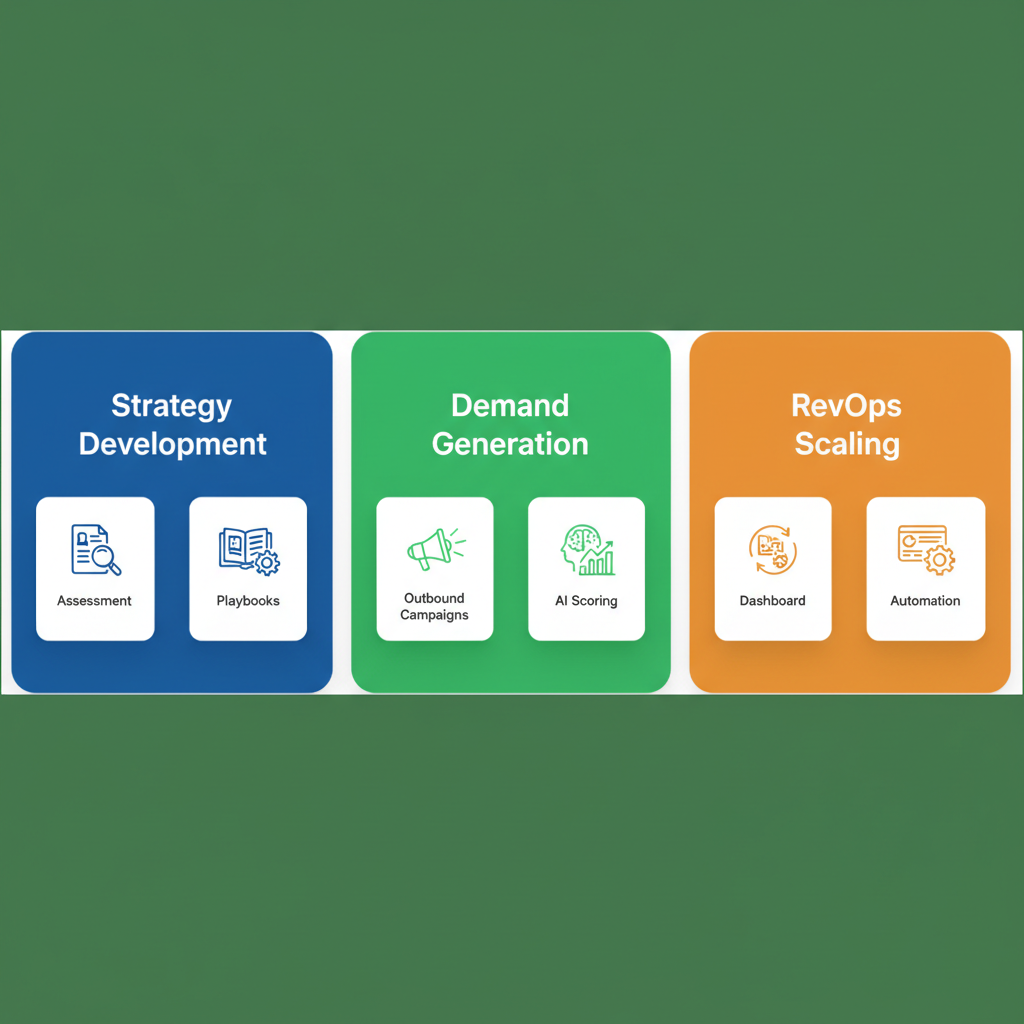
Three key stages in constructing effective GTM systems for B2B SaaS businesses
Icon grid showcasing benefits of hiring a B2B SaaS consultant for revenue growth
This visual representation highlights how our expertise accelerates time-to-market and fosters long-term scalability. By integrating multi-channel tactics and enriched data, we address common B2B hurdles like extended sales cycles and complex buyer personas, ensuring your SaaS product resonates with the right decision-makers.
Enhanced Demand Generation and Lead Quality
We deliver enhanced demand generation through targeted strategies that elevate lead quality for B2B SaaS companies. By leveraging AI-powered lead scoring and multi-channel outbound campaigns, our b2b saas marketing initiatives cut through noise to attract high-intent prospects. This results in shorter buying cycles and higher conversion rates, as evidenced by B2B product marketing trends emphasizing tailored messaging and ICP alignment.
Key benefits include:
- Accelerated lead acquisition: We deploy inbound, outbound, and ad-based tactics to generate qualified meetings, often seeing 25-40% uplift in prospect volume based on client benchmarks.
- Improved targeting: Using Voice of Customer research, we refine personas to focus on ROI-driven buyers, reducing wasted efforts on low-fit leads.
- Better engagement: Lifecycle campaigns sustain interest post-lead, boosting account expansion opportunities in competitive SaaS landscapes.
For example, a startup client in enterprise software achieved a 35% increase in sales velocity by shifting from generic outreach to personalized, industry-specific use cases. This ties directly to B2B SaaS success, where precise demand gen drives adoption and retention. Results vary by market conditions and execution, but our data-driven methods provide a strong foundation.
Streamlined RevOps and Revenue Predictability
Our RevOps infrastructure creates scalable, data-driven processes that eliminate silos and ensure consistent revenue growth for B2B SaaS firms. As a SaaS optimization expert, we implement automation, analytics dashboards, and playbooks to unify sales and marketing operations. Insights from B2B product management highlight the need for aligned roadmaps and attribution models, which we use to forecast outcomes accurately.
Benefits encompass:
- Operational efficiency: Automated workflows reduce manual tasks, enabling teams to focus on high-value activities like customer onboarding.
- Enhanced predictability: Real-time metrics such as NPS and time-to-value provide visibility into revenue pipelines, supporting proactive adjustments.
- Scalable growth: We build systems that handle increased volume without proportional cost hikes, ideal for startups expanding markets.
Consider a scale-stage service business that streamlined its processes with our support, achieving 20% more predictable quarterly revenue through unified data. This B2B revenue enhancer approach fosters collaboration between product, marketing, and sales, aligning on priorities like churn prevention. While outcomes depend on internal adoption, our weekly strategy calls ensure sustained progress.
Cost-Effective Optimization and ROI Focus
We emphasize cost-effective optimization by implementing performance-based adjustments in sales and marketing systems, maximizing ROI for B2B SaaS clients. Avoiding trial-and-error, our saas sales strategy includes dedicated conversion support and training, drawing from trends in revenue-focused product marketing to prioritize measurable impact.
Core advantages are:
- Resource savings: Expert guidance prevents costly missteps, with clients often recouping investments within 90 days via optimized GTM systems.
- Higher conversions: Sales enablement content and rep support improve close rates by 15-30%, based on competitive positioning best practices.
- ROI tracking: We monitor contracted metrics like sales velocity without unqualified promises, providing transparent reporting.
For instance, a B2B online service startup reduced acquisition costs by 28% through our business process optimization, focusing on enriched data and chatbot integrations. This delivers practical value, accelerating market entry while tying back to SaaS efficiency. Variability exists due to external factors, yet our end-to-end ownership guarantees alignment with your growth goals.
How B2B SaaS Consultants Build GTM Systems
At Growth Architects Group, we specialize in building revenue engines that scale for B2B companies with guaranteed results. As a leading B2B SaaS Consultant, our approach to constructing go-to-market (GTM) systems emphasizes predictable revenue through structured processes. We begin with thorough assessments and progress to full deployment, ensuring our clients achieve sustained growth. This methodology reflects our commitment to revenue engineering, where every element aligns toward efficient, data-driven outcomes.
Step-by-Step GTM Strategy Development
Our process starts with an initial kickoff assessment to evaluate the client’s current revenue architecture. We map out key pain points, target buyer personas, and existing sales funnels using data from internal tools and customer feedback. As GTM system engineers, we then craft a comprehensive strategy document that outlines messaging frameworks and value propositions tailored to B2B needs.
Next, we design the revenue playbook. This includes defining sales stages, qualification criteria, and objection-handling scripts. Drawing from established models like those in the Go-to-Market Strategy Guide, we incorporate best practices for alignment between sales and marketing. For instance, we prioritize high-intent lead definitions to streamline progression.
Finally, we validate the strategy through workshops and simulations. This 30-day phase culminates in a deployable blueprint, setting the foundation for execution. Our clients benefit from this structured approach, which accelerates time-to-revenue while minimizing risks.
Implementing Multi-Channel Demand Generation
Implementation kicks off with outbound campaigns, leveraging enriched data for personalized outreach. We deploy email sequences, LinkedIn InMails, and targeted ads to engage decision-makers in startups and scale-ups. As experts in b2b saas marketing, we integrate AI-powered lead scoring to prioritize prospects based on behavioral signals and firmographic matches, boosting conversion rates by focusing efforts on qualified opportunities.
Inbound funnels complement these efforts through content syndication and SEO-optimized assets. We build chatbots for website engagement and run paid search campaigns to capture organic demand. Referencing SaaS Sales Guide insights, our tactics emphasize active listening and product demonstrations to nurture leads effectively.
To enhance partnerships, we incorporate an affiliate referral program that incentivizes ecosystem allies to drive introductions. This multi-channel synergy, refined over bi-weekly reviews, ensures a steady pipeline within our 90-day deployment timeline. Sales support follows, with dedicated closers providing training to internal teams for seamless handoffs.
Icon grid showcasing benefits of hiring a B2B SaaS consultant for revenue growth
Three key stages in constructing effective GTM systems for B2B SaaS businesses
The diagram above visualizes how these stages interconnect, creating a cohesive GTM framework that supports long-term efficiency.
RevOps Integration and Scaling
RevOps integration is crucial for operationalizing the GTM system. We set up automation workflows using tools like HubSpot or Salesforce to handle lead routing and follow-ups. As SaaS process optimizers, we build analytics dashboards that track metrics such as pipeline velocity and win rates, providing real-time visibility into performance.
Developing a saas sales strategy playbook involves codifying processes for repeatability. This includes templates for demos, contract negotiations, and onboarding, informed by data-driven optimizations from the SaaS Sales Guide. We automate reporting cadences to flag bottlenecks early.
Scaling requires ongoing refinement through monthly reviews and quarterly audits. Our teams conduct strategy calls to adjust tactics based on emerging trends, ensuring the system adapts to growth phases. This sustained cadence delivers predictable revenue, with RevOps infrastructure enabling clients to focus on core business while we manage the engine.
By embedding these elements, we transform GTM systems into scalable assets that drive consistent results for B2B SaaS ventures.
Best Practices for Selecting a B2B SaaS Consultant
Selecting the right B2B SaaS Consultant can significantly impact your revenue engineering efforts. At Growth Architects Group, we emphasize a structured approach to ensure alignment with your go-to-market goals. By evaluating expertise and methodologies, you can build predictable revenue streams without unnecessary risks.
Key Evaluation Questions and Criteria
When choosing a B2B SaaS Consultant, start with essential questions to gauge their fit. We recommend assessing their experience in B2B environments, particularly in SaaS hiring guides for US-based operations. Ask about past projects: “Can you provide case studies of successful implementations in similar industries?” This reveals their track record in revenue engineering.
Next, probe methodologies: “What frameworks do you use for strategy development, such as the AIDA Model or STP segmentation from established marketing guides?” Effective consultants apply proven structures like Customer Journey Mapping to align with business needs. Also, inquire about guarantees: “How do you handle underperformance, and what are your terms of service?” Look for red flags, such as vague claims without data-backed results.
Finally, evaluate cultural alignment: “How do you collaborate with executive teams on sales and marketing systems?” As a B2B consultant selector, prioritize those who understand your ICP and offer tailored advisory services. This process, informed by comprehensive marketing frameworks, ensures long-term partnership potential.
Understanding Costs and Performance Expectations
Costs for a B2B SaaS Consultant vary by engagement type, typically ranging from retainers at $5,000-$15,000 monthly to project-based fees of $20,000-$100,000. We advise clarifying structures upfront, including fixed scopes versus hourly rates, to avoid surprises. For instance, revenue-focused projects might tie fees to milestones like lead generation campaigns.
Setting performance expectations requires realistic metrics. Discuss KPIs such as qualified meetings generated or conversion rates improved, but include disclaimers: outcomes depend on your data quality and market conditions, not absolute guarantees. We build revenue engines that scale for B2B companies with predictable revenue, yet emphasize contractual clarity to define success.
Examples include consulting for RevOps infrastructure, where consultants optimize playbooks and analytics for ROI. Always review terms of service to outline deliverables. This approach fosters transparency, ensuring investments yield measurable value without overpromising. Negotiate based on your scale-up needs, focusing on advisory and managed GTM operations for sustained growth.
Trends and Strategies for Long-Term Success
Emerging trends in b2b saas marketing for 2026 highlight AI-driven insights and unified product operations, as projected in recent B2B analyses. Consultants should demonstrate familiarity with these, such as AI-first customer segmentation to enhance targeting.
For saas sales strategy, prioritize those versed in lifecycle-based campaigns, including account expansion and churn prevention. We recommend strategies like Voice of Customer research integrated with product roadmaps, drawing from 2026 forecasts emphasizing ROI and scalability in B2B sectors.
To achieve long-term success, select consultants who incorporate growth hacking and Pirate Metrics (AARRR) for user acquisition and retention. Examples include AI-powered features for personalized outreach, aligning with digital transformation. Avoid generic advice; seek expertise in US market nuances, like compliance in sales enablement.
By focusing on these trends, your B2B consultant selector process ensures adaptive strategies. This builds resilient revenue engines, guaranteeing meetings and ROI through data-driven execution.
Achieving Sustainable Growth with B2B SaaS Consulting
In the dynamic world of B2B SaaS, achieving sustainable growth requires a strategic partnership with a GTM revenue system that aligns sales, marketing, and customer success. As a B2B SaaS Consultant, we emphasize structured go-to-market frameworks, demand generation tactics, and RevOps infrastructure to drive predictable revenue. Our expertise, drawn from holistic revenue leadership principles, integrates these elements for coordinated results, moving beyond rigid playbooks to customer-centric strategies. Data-driven approaches, including AI-powered lead scoring and analytics, validate effective processes, ensuring long-term scalability while addressing trends like economic shifts and technology disruptions.
Key takeaways include:
- Core Roles and Benefits: Unified leadership fosters superior coordination, empowering teams to adapt to customer needs.
- Proven Processes: Demand generation through multi-channel campaigns and RevOps playbooks optimizes performance.
- Selection Tips: Choose partners with performance guarantees and rapid deployment cadences for measurable ROI.
Reflecting on b2b saas marketing and saas sales strategy, we see how these elements build resilient revenue engines. As your SaaS growth partner and revenue system builder, we encourage assessing your current systems to identify optimization opportunities. Building revenue engines that scale for B2B companies with guaranteed results, we believe in predictable revenue and ROI through iterative, people-first evolution.