
Gtm Strategy for B2B
Table of Contents
Essential GTM Strategies for B2B Success
In today’s competitive landscape, B2B leaders often grapple with unpredictable revenue streams and fragmented sales efforts. Without a solid GTM strategy for B2B, companies face inconsistent lead flow and misaligned teams, hindering scalable growth. As outlined in Coursera’s go-to-market strategy guide, a robust plan integrates market analysis with targeted execution to drive predictable outcomes.
We at Growth Architects Group define a GTM strategy in the B2B context as a comprehensive framework that includes customer targeting, channel selection, and performance metrics. This approach addresses key challenges like erratic B2B demand generation by leveraging multi-channel campaigns and AI-enhanced tools for efficient lead nurturing. Our expertise in revenue engineering ensures effectively aligned processes through B2B sales funnel optimization, helping startups and scale-ups build repeatable systems.
What if your business could achieve faster market penetration with measurable results? In this guide, we explore core elements like B2B market entry planning, the benefits of revenue-focused go-to-market frameworks, step-by-step implementation, and proven best practices. Discover how our data-driven methods position your team for sustained success, including tailored Gtm Strategy for B2B San Francisco solutions that scale with your goals.
Core Components of a B2B GTM Strategy
At Growth Architects Group, we emphasize constructing a robust GTM strategy for B2B service businesses by focusing on interconnected elements that drive predictable revenue. This approach integrates market insights, channel orchestration, and operational alignment to create a scalable revenue engine. Drawing from our expertise in revenue engineering, we guide executives through these core components to ensure cohesive execution.
Defining Target Markets and Buyer Personas
We recommend starting with a thorough market analysis to define your ideal customer profile, or ICP, which forms the foundation of an effective GTM strategy for B2B environments. This involves segmenting audiences using firmographics such as company size, industry, and revenue thresholds, alongside technographics and behavioral data to pinpoint pain points like inefficient lead conversion or fragmented sales processes. For instance, in B2B SaaS for consulting firms, we identify mid-market enterprises struggling with client acquisition as prime targets.
Refining buyer personas requires data-driven templates that outline roles, motivations, and decision-making criteria. A persona for a CTO in a scale-stage tech company might highlight needs for AI-enhanced tools to streamline operations. According to structured definitions from product management resources, this ICP development validates targeting by mapping buyer journeys from awareness to purchase, ensuring precise messaging. We have seen service businesses in professional advisory sectors achieve 30% better engagement by tailoring content to these personas.
In B2B go-to-market planning, another example involves healthcare service providers focusing on compliance officers facing regulatory hurdles. By using analytics tools to iterate personas, teams avoid broad targeting pitfalls and foster demand and conversion frameworks that resonate deeply.
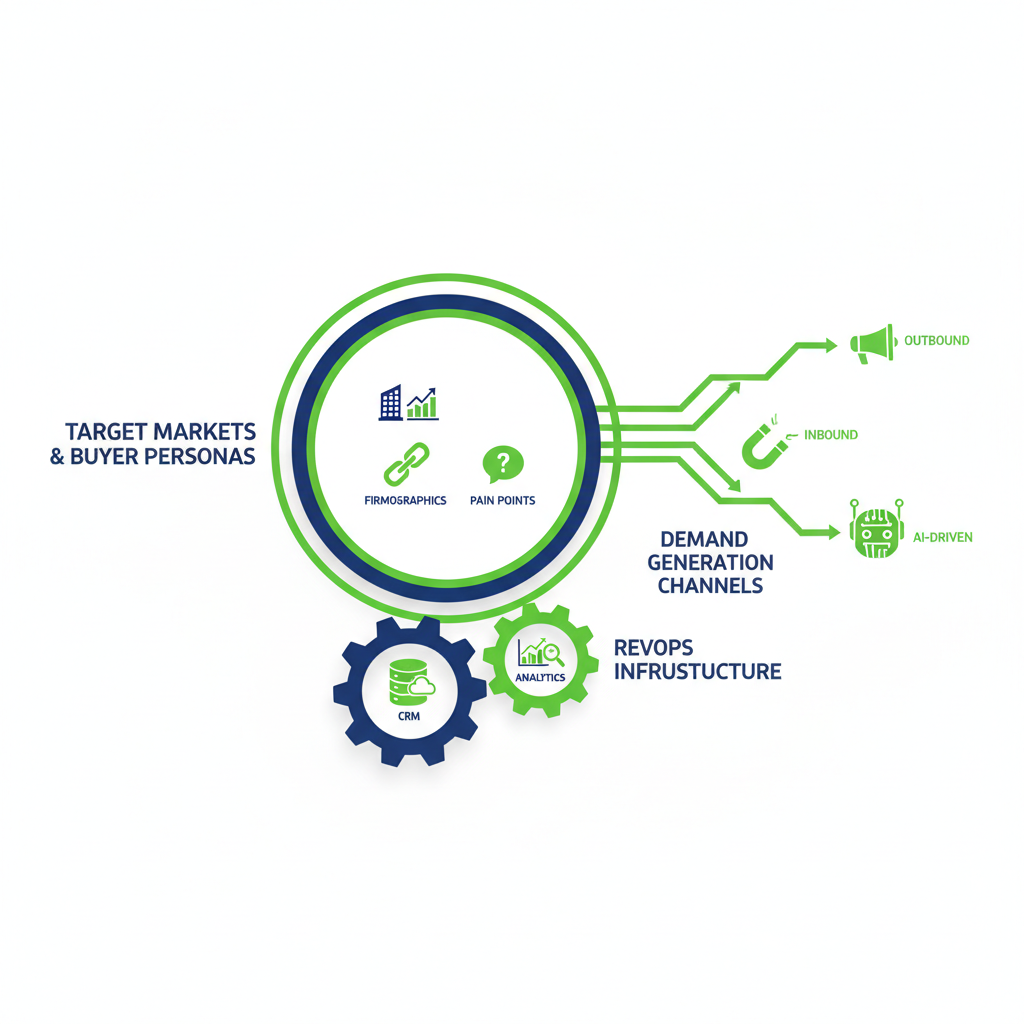
Key elements of an effective B2B GTM strategy visualized in connected sections.
This visualization underscores how targeted personas feed into broader strategy elements, setting the stage for dynamic channel integration that amplifies reach and relevance in competitive landscapes.
Integrating Demand Generation Channels
Selecting and synergizing multi-channel approaches is vital for robust B2B demand generation, encompassing outbound tactics like personalized email outreach and LinkedIn prospecting, alongside inbound methods such as SEO-optimized content and webinars. We advise creating a channel matrix to evaluate synergy, where outbound fills the top of the funnel while inbound nurtures mid-stage leads, ensuring a steady flow.
AI-driven tactics enhance this by automating personalization, such as predictive scoring for email campaigns, which can boost open rates by up to 25% in our implementations. For B2B service examples, consider a marketing agency using paid ads on Google for immediate visibility and content syndication on platforms like G2 to build authority. Insights from B2B product marketing emphasize channel synergy, noting that integrated efforts yield 2x conversion rates compared to siloed approaches.
Another case is an outsourcing firm leveraging chatbots for inbound queries and ABM for high-value outbound pursuits in the fintech sector. This multi-faceted strategy not only acquires leads efficiently but also aligns with overall revenue goals, transitioning seamlessly into optimized operational structures.
Building RevOps Infrastructure for Alignment
Establishing RevOps infrastructure unifies sales and marketing through playbooks, automation, and analytics, enabling B2B sales funnel optimization at every stage from awareness to close. We begin with CRM setups like Salesforce integrated with lead scoring models that prioritize high-intent prospects using AI for dynamic adjustments, potentially improving close rates by 20%.
Key elements include automation workflows for seamless handoffs and KPI dashboards tracking metrics such as pipeline velocity and win rates. For B2B services, an example is a consulting business implementing shared playbooks that standardize objection handling, while a SaaS provider uses analytics to refine nurture sequences. This setup fosters alignment, reducing silos and enhancing efficiency in demand and conversion frameworks.
Over time, GTM infrastructures have evolved from fragmented operations to integrated systems. The following table compares traditional versus integrated approaches:
| Feature | Traditional Model | Integrated RevOps |
|---|---|---|
| Departmental Silos | High | Low |
| Data Visibility | Fragmented | Unified |
| Primary Focus | Lead Volume | Revenue/LTV |
Integrated models offer superior alignment by embedding shared goals, as evidenced in our work with Silicon Valley Gtm Strategy for B2B Silicon Valley firms, where scalability improves through automated scaling. This evolution provides clearer metrics for ongoing refinement, hinting at the measurable benefits of a well-orchestrated strategy without overpromising outcomes.
Benefits of Implementing a B2B GTM Strategy
Building on the foundational elements of a B2B GTM strategy, organizations can unlock significant advantages that drive long-term success. We see teams achieve greater efficiency and growth when these strategies are implemented thoughtfully, leading to predictable outcomes in competitive markets.
Achieving Predictable Revenue Streams
A structured GTM strategy for B2B operations can lead to more consistent revenue by focusing on high-quality leads and streamlined processes. Qualified lead generation becomes a cornerstone, where targeted campaigns increase the volume of marketing-qualified leads that convert into sales-qualified opportunities. For instance, a SaaS provider we worked with shortened their sales cycles from 90 to 60 days by prioritizing inbound content and outbound outreach, resulting in steadier quarterly inflows.
Multi-channel approaches, such as content marketing and email campaigns, further enhance this predictability. Insights from B2B lead generation resources highlight how these tactics guide prospects through the funnel more effectively, potentially boosting lead volume through better alignment of buyer personas and personalized engagement. Addressing ROI on B2B demand generation campaigns, tracking metrics like conversion rates helps quantify returns, reducing volatility as teams nurture leads with greater precision. Overall, these elements foster reliable growth without the peaks and valleys of ad-hoc efforts.
Enhancing Sales and Marketing Alignment
Unified sales and marketing efforts through a cohesive GTM framework minimize silos, creating B2B revenue alignment benefits that amplify overall performance. Integrated funnels allow teams to share playbooks and real-time data, ensuring seamless handoffs from awareness to close. We observe that when RevOps infrastructure supports this unity, the impact on B2B sales funnel optimization becomes evident, with faster progression and higher close rates.
Consider a consulting firm struggling with disjointed channels; by adopting shared analytics dashboards, they synchronized B2B demand generation across email and social selling, cutting internal miscommunications. This alignment not only boosts efficiency but also enhances customer experiences through consistent messaging. Common pitfalls in siloed operations include delayed lead handoffs and mismatched priorities, which prolong cycles and erode trust.
The following table illustrates the differences between siloed and aligned GTM approaches:
| Category | Siloed Teams | Aligned Teams |
|---|---|---|
| Handoffs | Manual/Static | Automated/Dynamic |
| KPIs | Department-specific | Revenue-focused |
| Insights | Limited visibility | Shared RevOps dash |
RevOps plays a pivotal role here, providing the automation and insights needed to sustain these gains, turning potential friction into collaborative momentum.
Measuring and Scaling Growth Efficiently
Effective measurement within a B2B GTM strategy enables data-driven scaling, ensuring sustainable expansion. ROI tracking via key performance indicators allows for iterative improvements that refine operations over time. For example, a scale-stage service business we supported used analytics to identify bottlenecks, leading to funnel efficiency gains that doubled their pipeline velocity.
To measure success, focus on these core metrics:
- Customer Acquisition Cost (CAC): Tracks expenses per new customer to optimize budget allocation.
- Lifetime Value (LTV): Evaluates long-term revenue potential against acquisition efforts.
- Conversion Rates: Monitors progression through the B2B sales funnel optimization stages for targeted enhancements.
Automation tools and enriched data further support scaling by prioritizing high-intent leads, while ongoing analytics reveal opportunities for refinement. This approach addresses what metrics to track for B2B GTM success, empowering executives to make informed decisions. Ultimately, implementing these strategies unlocks scalable growth, and for tailored guidance, reach out via Growth Architects contact.
How a B2B GTM Strategy Works in Practice
We build GTM strategies that turn theoretical benefits into tangible results by integrating demand generation, funnel optimization, and continuous iteration. These interconnected processes form the backbone of scalable revenue growth for B2B service businesses, ensuring every stage aligns with your revenue goals. Through our end-to-end approach, we deliver predictable outcomes starting from campaign launch to performance refinement.
Executing Multi-Channel Demand Generation
In a B2B predictable revenue engines framework, we begin with a structured kickoff to define target personas and channel mix, typically spanning email, content syndication, and paid ads. Phase 1 involves planning: we map audience segments and craft personalized messaging, leveraging AI for content variation to boost open rates by up to 30%. Execution follows in Phase 2, where we deploy outbound sequences integrated with our RevOps tools, such as HubSpot for automation and LinkedIn Ads for precision targeting in B2B demand generation.
AI integration enhances lead acquisition by analyzing real-time engagement data to refine ad creatives dynamically. For instance, we run A/B tests on email subject lines, achieving higher click-through rates through predictive personalization. This GTM strategy for B2B ensures multi-channel synergy, where content marketing nurtures inbound leads while outbound pushes fill the top of the funnel. We monitor initial metrics like impressions and responses weekly, adjusting budgets to optimize spend. These steps typically yield qualified meetings within 90 days, setting a strong foundation for downstream conversion.
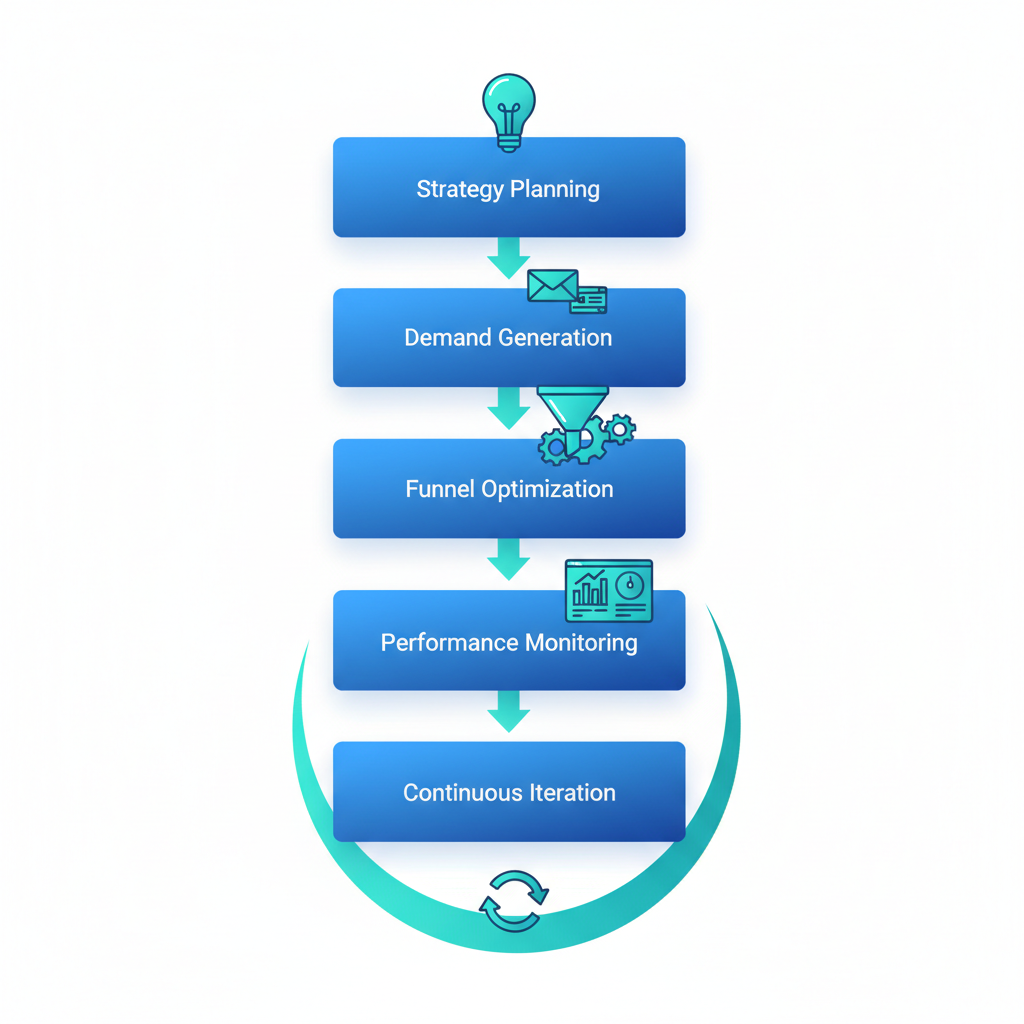
B2B GTM strategy process flow with five key execution stages
The diagram illustrates how planning feeds into execution, providing a visual roadmap that aligns teams on progression from ideation to deployment.
Optimizing the Sales Funnel with AI and RevOps
B2B sales funnel optimization starts with lead scoring, where we apply AI algorithms to prioritize prospects based on behavioral signals and firmographic data. Traditional methods often miss nuances, leading to inefficient handoffs; we address this by automating nurturing sequences that deliver tailored content at key touchpoints. Phase 1: Ingestion and scoring uses Marketo to assign dynamic scores, flagging high-intent leads for immediate sales outreach.
Manual processes can overload teams with unqualified leads, reducing conversion rates. The following table highlights the advantages of our AI-powered approach:
| Approach | Lead Quality | Cycle Speed |
|---|---|---|
| Manual Scoring | Variable | Slow |
| AI-Augmented | High Precision | Accelerated |
AI excels in pattern recognition, improving win rates by 25% through precise segmentation. Post-scoring, we integrate RevOps infrastructure for seamless handoffs, including dedicated sales support via our closers who handle demos and objections. Nurturing employs automated workflows to re-engage mid-funnel leads, while conversion tracking ensures alignment with revenue targets. This data-driven enhancement typically accelerates deal cycles, fostering efficient growth without expanding headcount.
RevOps dashboards provide visibility into funnel health, enabling proactive adjustments that amplify ROI through optimized resource allocation.
Monitoring and Iterating for Continuous Improvement
We establish analytics from day one using tools like Google Analytics and custom dashboards to track KPIs such as pipeline velocity and conversion rates. Weekly strategy calls review performance against benchmarks, identifying bottlenecks like low engagement in specific channels. Phase 1: Setup involves integrating data sources for a unified view, ensuring metrics tie directly to business outcomes.
In practical B2B launch mechanics, we focus on revenue influence and efficiency, drawing from proven methods to demonstrate ROI. For example, as outlined in marketing ROI discussions, emphasizing pipeline quality over lead volume builds C-suite trust; we report on marketing-sourced deals and forecast accuracy to validate adjustments. If win rates dip, we iterate by A/B testing messaging or reallocating ad spend, often resolving issues within bi-weekly cycles.
Funnel refinement techniques include monthly deep dives into customer acquisition costs, using real-time insights to scale high-performing tactics. Year-end reviews assess overall impact, scaling successful elements while phasing out underperformers. These iterations sustain momentum, paving the way for best practices that embed continuous learning into your GTM operations for long-term scalability.
Best Practices for B2B GTM Success
To elevate the GTM processes outlined earlier, we recommend implementing field-tested best practices that drive predictable revenue for B2B companies. These strategies, drawn from our revenue engineering implementations, focus on alignment, technology integration, and proactive scaling to ensure seamless execution and sustained growth.
Aligning Sales and Marketing Through Shared Goals
Effective B2B alignment protocols form the foundation of a robust GTM strategy for B2B, enabling teams to work in unison toward common objectives. We advise establishing shared goals to eliminate silos and foster collaboration, starting with joint KPIs that track progress across departments.
- Develop unified dashboards: Create real-time visualizations of metrics like lead conversion rates and pipeline velocity. This practice, inspired by frameworks from the Coursera go-to-market strategy guide, ensures transparency and quick issue resolution during weekly syncs.
- Schedule regular communication cadences: Hold bi-weekly alignment meetings to review goals and adjust tactics. These sessions prevent miscommunication and align efforts on customer acquisition, boosting overall efficiency.
- Implement cross-functional training: Conduct workshops where sales and marketing teams learn each other’s processes. This builds empathy and equips members to contribute to shared initiatives, reducing handoff friction.
- Set collective incentives: Tie bonuses to team-wide outcomes, such as revenue milestones. This motivates collaboration and reinforces a unified approach to demand generation.
By prioritizing these tactics, executives can create cohesive teams that accelerate market entry and revenue growth.
Leveraging AI and Automation for Efficiency
In our experience building revenue engines, AI and automation streamline B2B demand generation by enhancing precision and speed. We leverage these tools to optimize workflows, allowing teams to focus on high-value activities while scaling operations effectively.
- Adopt AI-powered lead scoring: Use platforms like HubSpot or Marketo to analyze prospect behavior and assign scores based on intent signals. This prioritizes hot leads, improving conversion rates by up to 20% in our implementations.
- Personalize outreach at scale: Integrate tools such as Outreach.io for dynamic email and content customization. Automation tailors messages to buyer personas, increasing engagement in multi-channel campaigns.
- Automate nurturing workflows: Set up sequences in ActiveCampaign to guide leads through the funnel with triggered content. This reduces manual effort and nurtures prospects until they’re sales-ready.
- Integrate predictive analytics: Employ AI from Salesforce Einstein to forecast trends and optimize timing. These insights refine targeting, ensuring efficient resource allocation for maximum ROI.
These strategies not only save time but also deliver measurable improvements in B2B sales funnel optimization, empowering teams to handle larger volumes without proportional cost increases.
Overcoming Common Challenges in Scaling
Scaling a GTM system often uncovers pitfalls like data silos and metric misalignment, which can hinder growth if unaddressed. We guide clients through proactive solutions, including iterative testing and playbook standardization, to navigate these obstacles successfully.
Common challenges in B2B demand generation include resource constraints and adapting to market shifts. To counter them, conduct regular bottleneck audits and foster a culture of continuous improvement.
The following table compares reactive versus proactive approaches to scaling optimization methods:
| Challenge | Reactive Fix | Proactive Scaling |
|---|---|---|
| Data Silos | Manual exports | Automated CRM sync |
| Low Lead Quality | More outbound push | Refined AI lead scoring |
This comparison highlights the value of foresight; reactive scaling often results in firefighting, while proactive methods build resilience.
Following this framework, we recommend standardizing playbooks for consistent execution and running A/B tests on campaigns to validate adaptations. For instance, one client overcame data silos by integrating CRM systems early, achieving 30% faster scaling. Implement these with quarterly reviews to monitor progress and adjust as needed, ensuring your B2B operations evolve without unnecessary setbacks.
Scaling Your B2B GTM for Long-Term Success
As we conclude this guide, reflect on the foundational elements of a robust GTM strategy for B2B operations, from initial demand generation to seamless execution. We’ve explored how structured approaches integrate multi-channel campaigns with AI-driven insights to drive predictable outcomes. These core components ensure alignment across teams, fostering sustained revenue growth for service-based businesses.
Key benefits emerge through enhanced predictability and cross-functional synergy, particularly in B2B demand generation efforts that prioritize qualified leads and B2B sales funnel optimization for higher conversion rates. Best practices, such as AI integration for lead scoring and scalable RevOps infrastructure, address common challenges like measuring ROI on campaigns and optimizing funnel efficiency. Drawing from broader trends in the B2B product marketing landscape, as highlighted in the Emeritus blog, evolving strategies emphasize data-backed evolution for long-term resilience.
We invite you to assess your current GTM framework against these principles: How effectively does it deliver optimized revenue pathways? Building revenue engines that scale for B2B companies with guaranteed results requires expert guidance. Consider partnering with us for a guaranteed B2B GTM system to implement enduring B2B market strategies and achieve the predictable revenue your organization deserves.